Defence Science and Technology Group has engaged DMTC Limited to extend its program of work on the Advanced Integrated Respiratory (AIR) Model. The HSSA collaboration brings together a team from Macquarie University, led by Dr Hui Ong, and Defence scientists. The AIR model is a physiologically relevant in vitro human respiratory system being developed to predict biological responses following the inhalation of chemical or biological aerosols.
Accurate in vitro models that replicate human respiratory physiology are essential for advancing research in aerosolised drug delivery, inhalation toxicology, and the characterisation of airborne agents. Three-dimensional (3D) printed respiratory models have gained prominence as tools for studying particle deposition within the respiratory tract, helping to address limitations associated with current in vitro and in vivo models.
Conventional in vitro cell culture systems enable controlled investigations of epithelial transport; however, they typically rely on liquid dosing, lack breathing mechanics, and do not reproduce the complex geometry of the human respiratory tract.
The AIR model incorporates a 3D printed nasal and tracheal modules derived from patient scans, together with a silicone-based lower airway representing the bronchi. A distinctive feature of the AIR model is its ability to incorporate air-liquid interface cultures of human respiratory epithelial cells, enabling more physiologically relevant investigation of aerosol-to-cell interactions.
The new phase of the HSSA-led program will build on previous work by:
- Benchmarking the AIR model against established in vitro respiratory testing systems
- Conducting simulations to predict aerosol behaviour throughout the AIR model
- Integrating additional geometries derived from patient scans to further extend the AIR model’s capability.
The AIR model is designed to be readily adaptable to a broad range of inhalational materials and scenarios, including environmental spores, agricultural dusts, and toxic industrial fumes. It is expected to generate data that may support future TGA and FDA regulatory submissions, while also facilitating progress towards clinical studies involving aerosolised medications and inhaler devices.
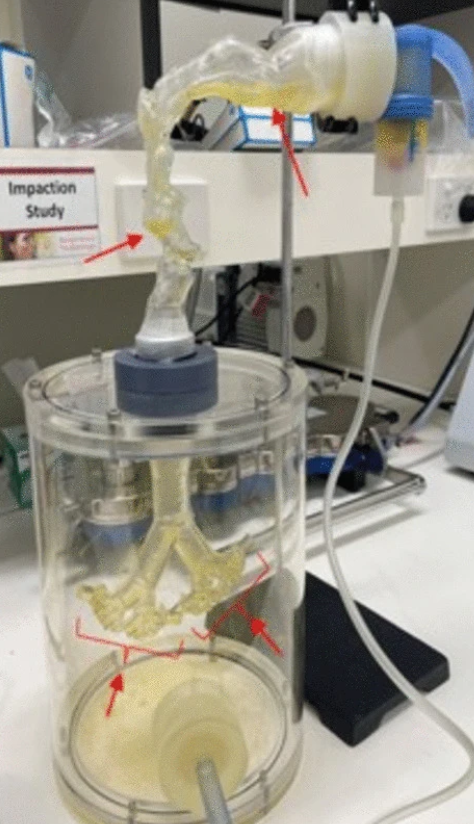
The experimental setup for simulating aerosol delivery using the AIR model. The annotated red arrows represent the highest
observed deposition of Flu-Na dye solution nebulised in the AIR model at 15 L/min flow rate.