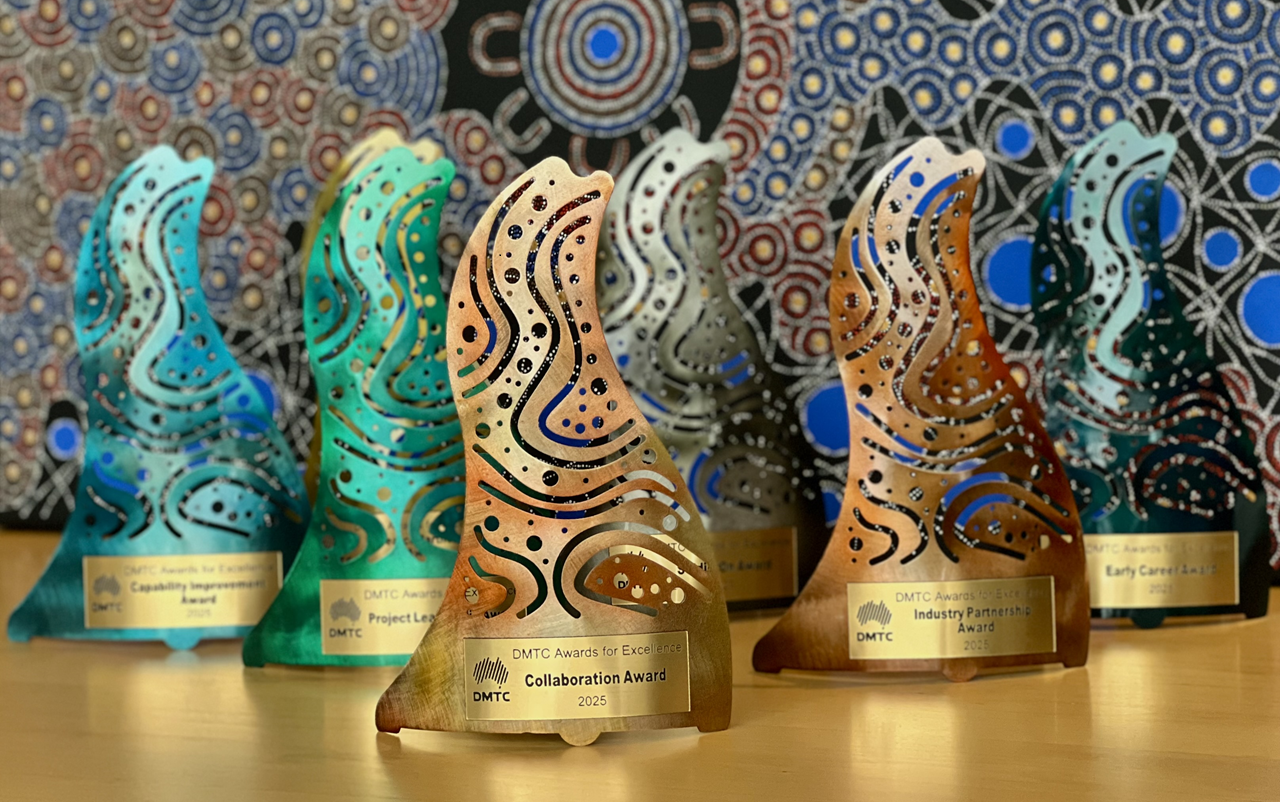
In 2025, DMTC made the difficult decision to cancel its Annual Conference as a result of a confluence of logistical challenges and external factors. Notwithstanding, DMTC remained committed to engaging with its stakeholders and celebrating outstanding contributions to DMTC from across its partner community, continuing its tradition of presenting annual Awards for Excellence.
From managing high-performing teams delivering decision support systems with defence and civilian applications to demonstrating industry-focused and research-informed leadership, advancing the manufacture of single crystal piezoelectrics and celebrating an up-and-coming early career researcher, this year’s Award for Excellence recipients are honoured across seven categories. These awards recognise individuals and project teams that reflect DMTC’s commitment to collaboration, innovation, excellence and delivery of defence, national security and health security capability outcomes.
Collaboration Award – Dr Peter Dawson (Defence Science and Technology Group)
Often described as DMTC’s ‘MVP Award’, the Collaboration Award was presented to Dr Peter Dawson for his leadership across multiple decision support system projects, including the EpiDefend early warning system, vector-borne disease forecasting capability, and surveillance decision support initiatives. Peter’s open, collaborative approach and proactive engagement have been critical to the success of these projects, with his tireless advocacy of the next stage sponsorship for projects he has led being critical in securing momentum that drives capability development forward.
Sharing DMTC’s wish to push the development of often overlooked health security assets, Peter was an early advocate for DMTC’s Health Security Systems Australia (HSSA) Division and sits on HSSA’s Divisional Advisory Panel. He has been a strong ally and fount of wisdom for DMTC’s health security efforts and as such is very deserving of this accolade.

SoldierOn Award – Dr Shannon Ryan (Deakin University)
The SoldierOn Award recognises a ‘quiet achiever’ who embodies DMTC’s values and demonstrates exceptional work ethic and a sustained and consistent record of impactful contributions to DMTC objectives. Dr Shannon Ryan from Deakin University has been a long-time contributor to DMTC projects. Shannon’s previous work with DMTC focused on the applicability of emerging classes of ferrous and non-ferrous materials in the land vehicle domain, relevant to his role as the discipline lead in Land Vehicle Survivability for Defence Science and Technology Group (DSTG) at that time. More recently, DMTC has benefited from Shannon’s expertise in the use of machine learning and AI to solve complex engineering problems. Shannon’s collaborative approach, work ethic and resolute focus on outcomes make him a worthy winner of this award.
Industry Partnership Award – Dr Niroj Maharjan (Swinburne University of Technology)
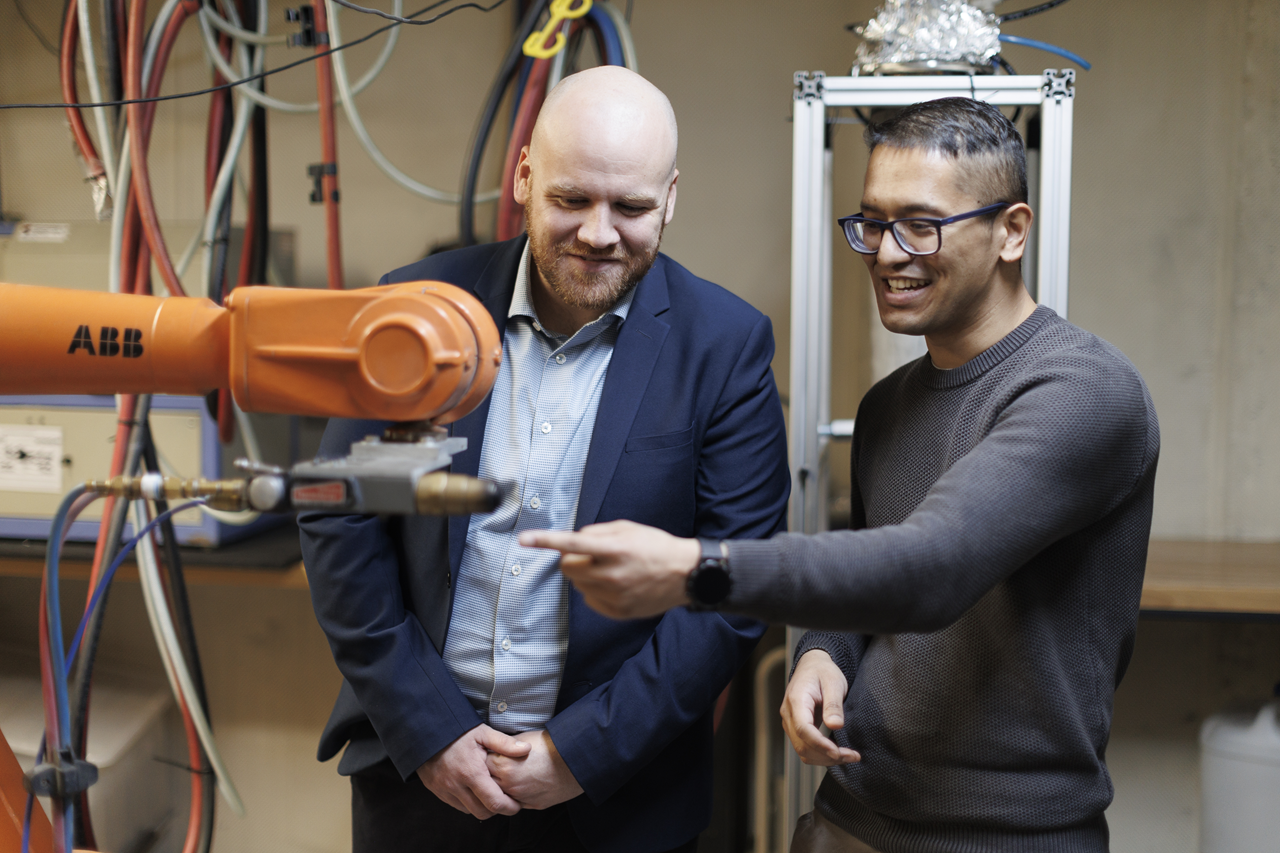
The Industry Partnership Award was presented to Dr Niroj Maharjan (pictured below with Dr Mitch Dunn, DMTC Program Leader) for his contributions to a project developing a range of cutting-edge thermal barrier coatings and thermal protection systems. His research expertise has been instrumental in advancing these innovative coating technologies and protection systems, which have significant applications for hypersonic vehicles and other technologies of this kind. Niroj’s work has strengthened the project’s standing for future investment and the team has high hopes that it will be able to support the advancement of these sovereign capabilities that are well-aligned with the stated hypersonic technology ambitions of AUKUS Pillar II.
Research Partnership Award – Michael Joffe (Planet Innovation)
Michael Joffe received the Research Partnership Award for his key role in the initial phases of DMTC’s Compact Aerosolised SARS Exposure Sentinel (CASES) project within the Company’s HSSA portfolio. The CASES project is developing a ruggedised wearable sensor capable of continuously detecting airborne biological threats. Michael’s expertise and commercial acumen were pivotal contributions to providing industrial context, clarity and purpose for the project’s research team. This exemplifies the very best of science and technology collaboration and the enduring linkages DMTC is committed to fostering.

Capability Improvement Award – APMA Program
DMTC’s APMA Program was awarded the Capability Improvement Award in recognition of breakthroughs in the sovereign supply of advanced single crystal piezoelectric materials for undersea sensors and transducers relevant to Defence undersea warfare applications.
The APMA Program, led by DMTC and supported by the DSTG and the Advanced Strategic Capabilities Accelerator (ASCA) through its Emerging and Disruptive Technologies Program, is a long-term strategic collaborative effort between Defence, DMTC, industry and the research sector.
Early Career Researcher Award – Dr Saras Windecker (The Kids Research Institute Australia)
The Early Career Researcher Award went to Dr Saras Windecker for her outstanding contributions to HSSA’s Biosurveillance Decision Support System project. As part of her responsibilities on the project, Saras has been an important member of the team developing an automated computational pipeline that fits a range of mathematical models to data and provides decision-makers with the information they need to respond to infectious disease emergencies. Saras’s innovation in applying the R-programming language, in the context of work-flow management, to generate a high-quality computational pipeline has been particularly noteworthy, as has her ability to navigate the complexities of a multi-institutional project with professionalism. There is little doubt that Saras is a rising leader in her field.
Project Leader Award – Dr Stefanie Buchholz (Griffith University)
Recognised for her exemplary leadership, Dr Stefanie Buchholz received the Project Leader Award for her work with a cross-disciplinary team from Griffith University. The University of Western Australia, the New South Wales Department of Primary Industries (Elizabeth Macarthur Agricultural Institute) and the Australian Rickettsial Reference Laboratory that is advancing a biopolymer vaccine platform. Under her leadership, the project team achieved a number of major milestones, including completing a successful technology transfer to a Contract Development and Manufacturing Organisation and establishment of a good manufacturing practice-certified master cell bank for a Q fever (Coxiella burnetii) vaccine. These achievements have significantly de-risked the technology and pushed forward clinically enabling activities.